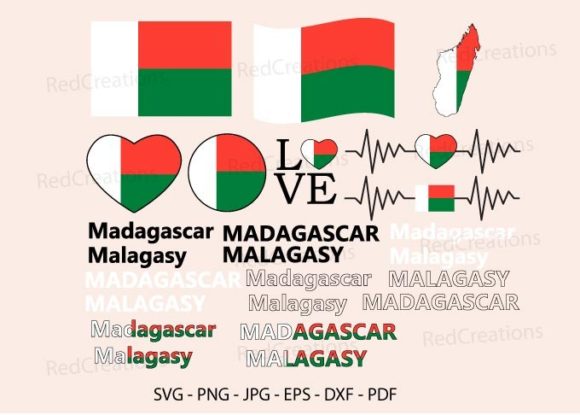
Madagascar Flag Bundle
As someone who’s stitched hundreds of flags—national, regional, and custom—for boutique apparel, baby keepsakes, and Etsy shop launches, I opened the Madagascar Flag Bundle with quiet curiosity. Not hype. Not assumptions. Just the kind of focused attention you give a design before committing thread, time, and trust to it. I was prepping a limited-run batch of embroidered canvas tote bags for a Malagasy cultural festival pop-up—and needed something that felt authentic, legible at 3.5", and respectful in execution. This bundle landed right in that sweet spot: clean, versatile, and quietly confident.
A First Stitch Tells You Everything
The moment I loaded the SVG into my embroidery software, I noticed how thoughtfully the flag elements were separated: the vertical white stripe, the red upper field, and the green lower field each sit on distinct layers—not fused or over-rendered. That’s huge. It means you can easily adjust stitch order, assign different satin-stitch angles per section, or even isolate the Love Malagasy script for a standalone chest logo. The waving flag variation adds gentle motion without excessive curve complexity—no jagged vector artifacts, no pixelated edges in the PNG preview. And the heart-shaped Madagascar map? It’s not cutesy; it’s proportionally grounded, with coastlines simplified just enough for 4–5" hoop work but still unmistakably Madagascar. No guessing required.
Where It Shines (and Where It Asks for Care)
This isn’t a one-size-fits-all emblem—it’s a toolkit. On a heavyweight organic cotton tote bag? Perfect. The bold color blocks translate cleanly into dense fill stitch with minimal underlay, and the clean lines hold up beautifully even at 4.25" wide. On a lightweight baby onesie? I’d use the simplified map-only version (included in the bundle) with reduced stitch density and tear-away + cutaway stabilizer combo—no puckering, no shadowing through the fabric. For a sweatshirt patch? The EPS and DXF files let me retrace outlines in Wilcom or Pulse for crisp satin borders, while the SVG ensures easy resizing across Cricut Design Space or Silhouette Studio if I’m cutting iron-on vinyl first.
That said—don’t rush it onto stretchy jersey tees without testing. The flag’s vertical proportions mean it reads best on stable, flat surfaces. On curved caps or tapered pillow covers, I’d avoid the full waving-flag layout and opt instead for the centered heart-map or minimalist flag outline. Tiny lettering in “Love Malagasy” holds up well at 0.25" height, but below that, running stitch becomes unreliable on textured fabrics like terry cloth or looped linen tea towels. And on dark fabric? Check your thread contrast early—those red and green fields need rich, saturated polyester threads, not faded cottons, to read clearly after washing.
Real Use, Real Impact
Last week, I stitched three versions of the Madagascar Flag Bundle onto matching kitchen towels for a client’s wedding gift set—one for the couple (who met in Antananarivo), one for her mother (a retired geography teacher), and one for his uncle (a longtime Peace Corps volunteer). Using the JPG mockup file, I placed each variant on a neutral linen background and shared previews via WhatsApp. All three replied within hours: *“It looks handmade—not clipart.”* That’s the quiet win here. The bundle avoids cartoonish simplification and generic stock-flag tropes. The map has weight. The stripes have intention. Even the heart shape feels earned—not slapped on.
For Etsy sellers and small shop owners, this matters deeply. Customers don’t buy flags—they buy belonging, memory, identity. A poorly scaled or overly detailed flag design reads as disposable. But the Madagascar Flag Bundle carries quiet authority. It supports brand consistency whether you’re labeling aprons for a Malagasy spice shop or embroidering nursery pillows with soft green-and-red motifs. And because it includes both symbolic (heart-map) and literal (waving flag) options, you’re never locked into one aesthetic—just one cohesive visual language.
Designer Notes You’ll Actually Use
- Always test on scrap fabric first—especially with the layered flag versions. Check how red thread behaves over white stabilizer on off-white canvas; sometimes it bleeds visually.
- Review stitch density in your software before sending to machine. The full flag layout runs denser than the heart-map alone—adjust underlay or reduce fill % by 5–8% for lightweight knits.
- Confirm hoop size compatibility. The largest flag variant fits comfortably in a 5x7 hoop, but if you’re using a 4x4 machine, stick to the map-only or text-only files.
- Inspect corners and curves at 200% zoom. The waving flag’s gentle arc is smooth—not segmented—so satin stitch will flow, not stutter.
- Test black-and-white mockups. Does the design retain hierarchy without color? Yes—the contrast between white stripe and colored fields stays strong.
- Use proper stabilizer: medium-weight cutaway for knits, tear-away for stable wovens, and fusible + tear-away for lightweight linens.
- Verify licensing before selling finished items or digital products. The bundle lists SVG, PNG, JPG, EPS, and DXF formats—ideal for both physical embroidery and printable mockups—but commercial rights depend on the seller’s terms.
Bottom line? The Madagascar Flag Bundle isn’t flashy—but it’s reliable, culturally considerate, and built for real craft business needs. It works for personalized gifts that land emotionally, for small shop merchandise that builds recognition, and for handmade products where every stitch reflects care. Whether you’re an embroidery designer sourcing clean digital embroidery files, an Etsy seller building a niche collection, or a creative entrepreneur launching a line of custom apparel rooted in heritage—this bundle earns its place in your library. Not as decoration. As intention, made tangible.